Five WhatsApp follow-up messages that actually get replies
Short, friendly WhatsApp templates your team can send after a first enquiry — when to send each one, and how to automate follow-up without annoying the customer.
- Reply within minutes, then follow up in stages instead of one long message.
- Ask for one thing per message: a question, a time slot, or a piece of information.
- Stop as soon as the customer replies, and respect a customer who does not want more messages.
- Messages outside the 24-hour window need WhatsApp-approved templates — prepare them in advance.
1Why most follow-up messages fail
Customers usually ask several businesses before they decide, so the conversation tends to stay with whoever replied first and was useful. Messages like “Are you still interested?” fail because they are generic, too long, badly timed, and give the customer no clear reason to answer.
The fix is not a cleverer message. It is a short sequence of small messages, each offering something useful or asking one easy question.
2Before you start: three WhatsApp ground rules
- Message people who contacted you. A customer who sent an enquiry expects a reply. Promotional messages to people who never asked can hurt your reputation and get your number blocked.
- Mind the 24-hour window. On the WhatsApp Business Platform you can reply freely within 24 hours of the customer’s last message. After that you can only send message templates that WhatsApp has approved in advance.
- One message, one request. If you ask the customer for three things in one message, they will usually do none of them.
3The five messages: what to send and when
The wording below is a template to adapt, not to copy word for word. Match your own tone, and add the customer’s name and one real detail from their enquiry to every message.
«Hi [Name], this is [Your name] from [Business]. I got your question about [service] and want to point you to the right option. Would you prefer [option A] or [option B]?»
Speed matters more than wording here. A closed question (A or B) lets the customer answer in a single word.
«[Name], I put together what customers usually ask before [service]: [point 1] and [point 2]. Happy to explain any of them in more detail.»
It shows you are helping, not chasing. Pick information that answers a real question, not an advertisement.
«[Name], I can set up a short intro call (10 minutes). Would today at 4 pm or tomorrow at 11 am work better?»
Specific options are easier to accept than “When are you free?”.
«Many of our customers ask about [common objection, such as price or delivery time]. The short answer: [an honest, clear answer]. Want me to send the details?»
Customers often go quiet because of a concern they have not voiced. Name it yourself, honestly. Use only real experiences and never invent figures.
«[Name], I don’t want to bother you with more messages. If now is not a good time, that is completely fine, and I can check back in two weeks if you like. If you would rather not hear from me, just say so and I will stop.»
A closing message respects the customer and often prompts hesitant people to reply. After it, stop.
4Adapt the messages to your business
The structure stays the same, but the words change from one business to another. Here is what to change in each message:
- Clinics and health services: make message three an appointment offer, and avoid detailed medical information in the chat.
- Real-estate offices: ask about the city and rough budget in message one, and send only suitable options in message two.
- Agencies and professional services: make message two an example of past work, and message three a short call to scope the requirements.
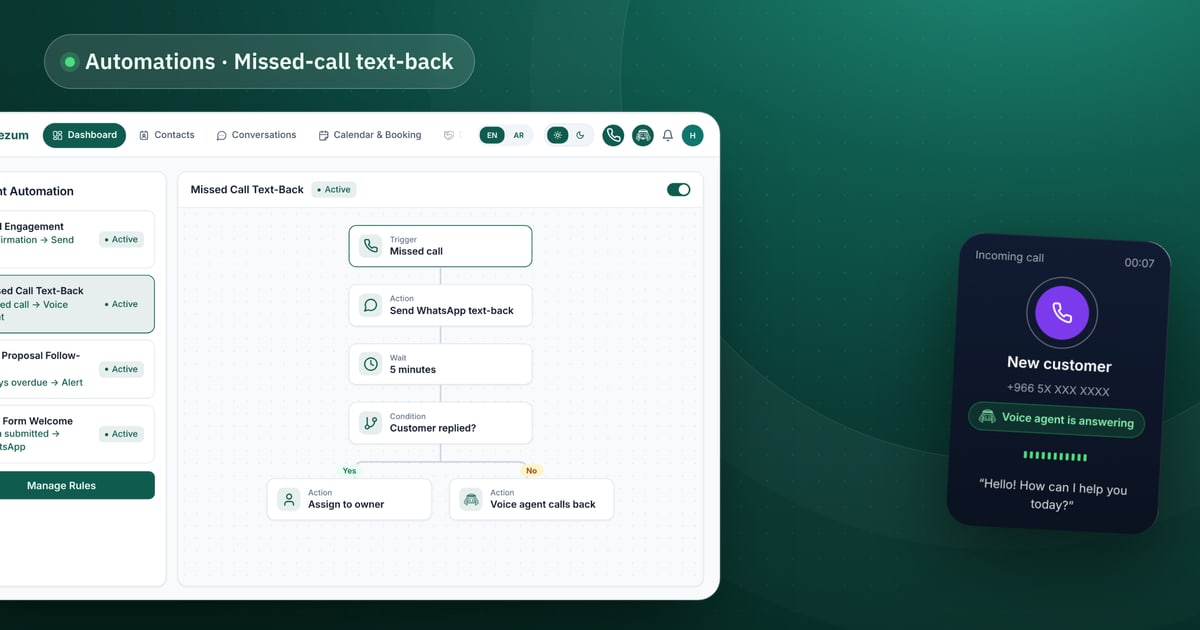
If the enquiry first arrived as a missed call, start with the automatic reply described in our article how to stop losing leads after a missed call, then move into this sequence.
5When to stop following up
- As soon as the customer replies, even with “later”. Move into a normal conversation handled by your team.
- The moment the customer asks not to be contacted, or sends a word like “stop”. Record it straight away and do not message again.
- After the fifth message. Anything beyond that adds annoyance, not results.
6How to automate this sequence in Rakezum
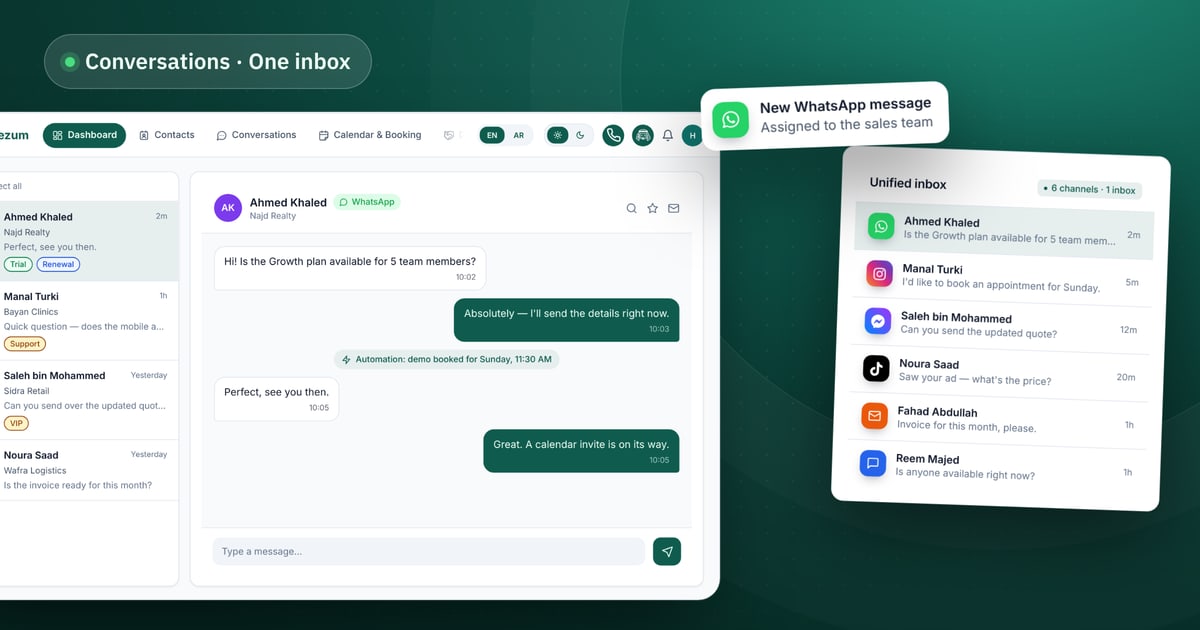
Rakezum brings WhatsApp, Instagram, Messenger, email and live chat into one inbox, so your team sees the whole conversation before any follow-up. In the automation module you build the rule as trigger → condition → action:
- Trigger: a new enquiry arrives from a lead.
- Condition: the customer has not replied after the wait you set for each message.
- Action: send the next message in the sequence, and stop the whole sequence at the first reply.
Alongside that you can assign the conversation to a team member, snooze it until the follow-up date, and add tags such as “trial” or “renewal” so you know where each customer stands. You can switch rules on or off whenever you like.
7Common mistakes
- Sending the identical message to every customer, with no name and no detail from their enquiry.
- Long blocks of text. Keep each message to two or three lines.
- Following up forever, or failing to stop on reply, so the customer gets an automated message after already talking to your staff.
- Messaging late at night or during rest hours. Stick to your customer’s normal working hours.
?Frequently asked questions
How many follow-up messages are enough?
Three to five messages over about a week. Beyond that you add more annoyance than replies.
Should I use voice notes?
You can in an ongoing conversation if the customer sends voice notes themselves, but keep the first message short and written.
What is the best time to send a follow-up?
During your customer’s normal working hours, away from prayer times and rest hours. Try different times and watch when replies arrive.