How to stop losing leads after a missed call
A simple text-back rule turns missed calls into conversations. Setup steps, ready-made message examples, and the numbers to track.
- A caller who finds no one to answer will often phone someone else within minutes.
- A text-back rule sends a message seconds after the missed call, keeping interest alive.
- Three steps: an instant message, a lead recorded in the system, and a follow-up task for a named person.
- Stop the automation on the first reply, and measure with four simple numbers.
1Why the first missed call costs you the lead
Someone who phones your business usually wants an answer now: a price, an appointment, a confirmation. If nobody picks up, they move on to another business. Worse, many businesses never record the missed call at all, so no one on the team even knows a customer tried to reach them.
2What is a missed-call text-back rule?
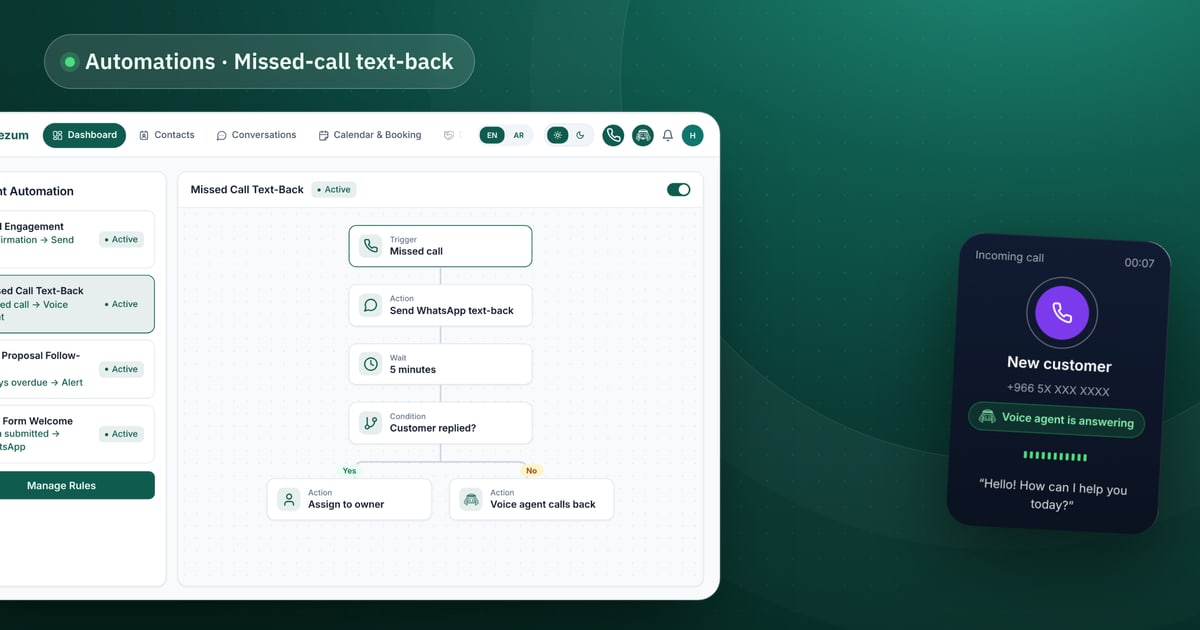
It is a simple automation built as trigger → condition → action: when you miss a call (trigger), from a number you have not dealt with before or during certain hours (condition), the caller receives a message offering help, and a lead and a follow-up task are created for your team (action).
3Setting it up step by step
- Define your working hours. You will need two messages: one for open hours and one for closed hours.
- Write the message. Keep it short, name your business, promise a specific reply time, and ask one question.
- Choose the channel. WhatsApp if the caller uses it and it suits your business, or SMS. If you use SMS, check your provider’s sender-name requirements.
- Record the lead. Create a contact and an opportunity in your pipeline so the call is not lost.
- Assign a task. Name one person who will call the customer back by a set time.
- Stop on reply. If the caller answers or phones again, send nothing automatic.
- Test it. Call your own number from another phone and check that the message arrives and the lead and task are created.
4Ready-made message examples
«Hello, this is [Business]. We missed your call and apologise. Our team will phone you back within [30 minutes]. If you prefer, we can continue here on WhatsApp. Just tell us how we can help.»
It gives the customer a specific time and an alternative way to write instead.
«Hello, this is [Business]. We received your call outside our working hours. We open tomorrow at [time] and will contact you first thing. You can write your question here and we will reply as soon as we can.»
It reassures the customer that the call was logged and someone will reach out.
5What happens after the message? The human call-back
The automatic message only buys you time. What turns a caller into a customer is a quick, organised human call-back. Agree these points with your team:
- A clear deadline: for example, call back within 30 minutes during working hours and first thing in the morning for anything missed outside them.
- A named owner: one person per task, not “the team” in general.
- A simple call script: introduce yourself, ask what the customer needs, then propose the next step: an appointment, a quote or a visit.
- Recording the outcome: move the lead to the right pipeline stage so it does not hang in limbo.
If the caller does not pick up on the call-back, move to a short WhatsApp follow-up sequence as described in our article on the five follow-up messages.
6Miss fewer calls in the first place with the voice agent
A text-back handles the call after it is missed. Rakezum’s voice agent answers your customers’ calls instantly with AI, so fewer calls are missed to begin with. In the automation module you can route a call to the voice agent instead of leaving it unanswered.
7Measure the result
- Missed calls per week, so you know the size of the problem before and after the fix.
- The share of callers who reply to your message.
- The time from the missed call to the first human contact.
- The number of leads that started as missed calls and became deals.
8Common mistakes
- Sending more than one automatic message to the same caller.
- Sending the auto-reply to existing customers your team already knows, which feels careless. Exclude them with a condition.
- Promising a reply time your team does not keep.
- Forgetting the task: the message only buys you time. A human call is what closes the deal.
?Frequently asked questions
Should I use WhatsApp or SMS?
WhatsApp usually fits better because it opens a conversation you can continue. SMS is the alternative when WhatsApp is not an option, after checking your provider’s requirements.
Does the automatic message annoy customers?
Not if it is a single, short, useful message with a clear promise. What annoys people is no reply at all.
Does the rule work outside working hours?
Yes, as long as you write a different message for closed hours that states when you reopen, and schedule the follow-up task for the next morning.